
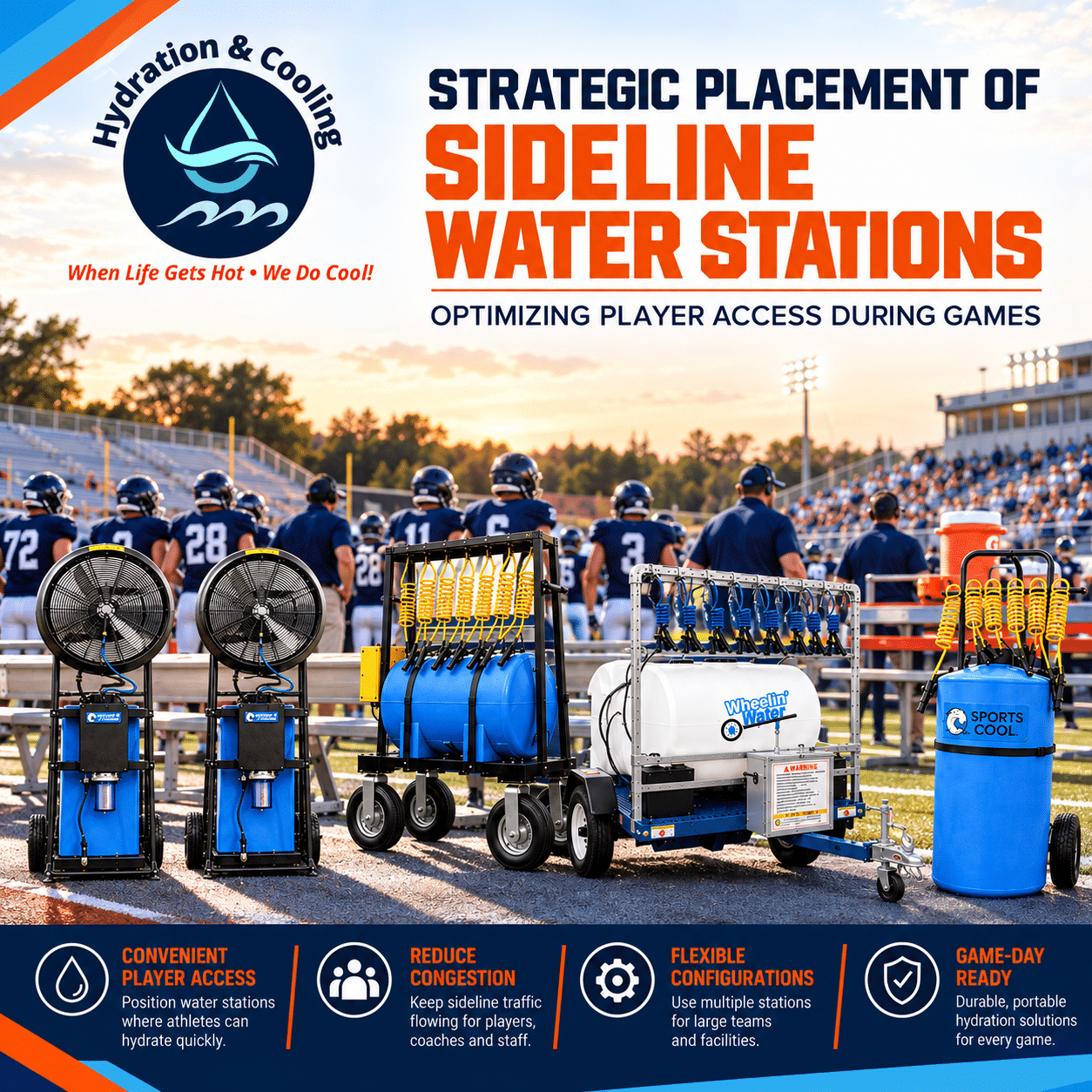
Sideline water station placement is an important part of organizing hydration during athletic competitions. The equipment needs to be accessible to athletes while remaining clear of active play, coaching areas, officials, equipment traffic, and other sideline operations.
A well-planned sideline hydration setup considers more than simply placing a water cooler near the bench. Athletic programs should evaluate the location of the team area, available sideline space, player movement, equipment capacity, dispensing access, water replenishment, and the facility’s rules for sideline equipment.
Portable hydration equipment can give teams more flexibility because water can be positioned where athletes and staff need it rather than requiring everyone to travel to a fixed water source. Hydration & Cooling offers portable water cooler carts, hydration stations, team water tankers, and other equipment designed for athletic programs.
This guide explains how to approach sideline water station placement, how to reduce congestion around hydration equipment, and how to select equipment that fits the team’s facility and game-day operations.
Featured Snippet: Where Should a Sideline Water Station Be Placed?
A sideline water station should be positioned where athletes can access it conveniently during authorized breaks without interfering with active play, coaching areas, officials, or normal sideline traffic. The best location depends on the sport, team area, facility layout, equipment size, and number of athletes using the station. Larger teams may benefit from multiple hydration points rather than concentrating all equipment in one location.
TL;DR
- Place sideline water stations close enough for practical player access but outside active play areas.
- Keep clear paths around the station so athletes, coaches, trainers, officials, and equipment staff can move safely.
- Consider multiple hydration points when one station would create congestion.
- Match station capacity to the number of athletes who need access at the same time.
- Use mobile hydration equipment when the station needs to be repositioned between practices, games, or facilities.
- Consider sunlight, weather exposure, water replenishment, storage, and transportation when selecting a location.
- Follow the venue’s rules for equipment placement and keep hydration equipment out of restricted areas.
- Larger team hydration systems and smaller water cooler carts can be used together when the facility requires different hydration points.
- Sideline hydration is one part of a broader hydration and heat-safety plan.
Table of Contents
Why Sideline Water Station Placement Matters
The location of a hydration station affects how easily athletes can reach it during breaks and how well the equipment fits into the overall sideline operation.
A station that is too far from the team area may require unnecessary movement. A station positioned directly in a high-traffic area can create congestion. Equipment placed too close to active play may also interfere with normal game operations.
The goal is to establish a designated hydration area that is:
- Accessible to the athletes who use it
- Easy for staff to monitor and replenish
- Outside active playing areas
- Compatible with team and venue operations
- Large enough to accommodate the equipment
- Practical for moving and storing the system
Current Hydration & Cooling guidance for football hydration emphasizes positioning equipment to balance accessibility with the physical layout of the sideline and surrounding team areas.
How to Choose a Sideline Water Station Location
There is no single placement that works for every sport or facility. Start by evaluating the physical environment.
1. Identify the Team Area
Begin with the location where players spend most of their time between periods of play.
For football, this may be the team bench and surrounding sideline area. For soccer, lacrosse, baseball, softball, or other sports, the team area and field configuration may be different.
The hydration station should be convenient to the team without becoming an obstruction.
2. Keep Equipment Outside Active Play
Hydration equipment should not be positioned where players, officials, or equipment could collide with it during active play.
Leave an appropriate buffer between the hydration station and the playing surface while maintaining practical access for the team.
Venue requirements should always take precedence. Some facilities have specific rules governing where sideline equipment can be placed.
3. Consider Player Movement
Watch how players move during the game.
Ask:
- Where do players enter the sideline?
- Where do substitutes gather?
- Where do coaches stand?
- Where do athletic trainers work?
- Where is equipment stored?
- Where do players go during breaks?
- Which areas experience the most traffic?
The answers can help identify a location that provides access without creating a bottleneck.
4. Consider Staff Access
The hydration station also needs to work for the people responsible for filling, cleaning, moving, and maintaining it.
Staff should be able to:
- Refill the system
- Add water or ice when appropriate
- Inspect dispensing components
- Move the unit
- Clean the equipment
- Access supplies
A location that is convenient for players but difficult for equipment managers may create operational problems later.
Creating Efficient Player Access
The objective isn’t simply to put water near the field. It is to create an organized hydration point that fits the way the team operates.
Use a Defined Hydration Zone
A clearly identified hydration area can help players and staff understand where the equipment belongs.
The zone should provide enough space for:
- Players approaching the station
- Players leaving the station
- Staff servicing the equipment
- Equipment doors, lids, hoses, or dispensing components
- Additional supplies
Avoid positioning the station where incoming and outgoing traffic crosses unnecessarily.
Consider the Number of Dispensing Points
Equipment capacity should be considered alongside the number of available drinking positions.
A larger tank does not automatically mean faster access if only a few athletes can use the dispensing system at once.
For example, the current Hydration & Cooling Sports Cool Rolling Powered Team Drinker is a 20-gallon mobile system with six retractable drinking hoses.
That type of equipment can be useful where a smaller, mobile hydration point is more practical than a large team tanker.
Consider the Team’s Equipment
Football players wearing helmets and pads may have different access requirements than athletes in soccer, lacrosse, baseball, softball, or other sports.
Hydration equipment should therefore be selected based on how athletes actually use it rather than simply choosing the largest available system.
Avoiding Sideline Congestion
One of the most common placement problems is concentrating too many activities around one small area.
A sideline may already contain:
- Players
- Coaches
- Athletic trainers
- Team managers
- Benches
- Sports equipment
- Medical equipment
- Communication equipment
- Water and cooling equipment
Adding a large hydration station without considering the existing layout can make the sideline harder to manage.
Create Clear Entry and Exit Paths
Players should be able to approach the station, use the dispensing equipment, and move away without blocking other players.
If the station is serving a large group, consider the direction of player movement and whether a second station would distribute traffic more effectively.
Separate Hydration From Other Operations
Where possible, avoid placing the water station directly beside equipment areas that already experience heavy traffic.
The hydration area should have enough space for staff to service the system without interfering with coaching or other sideline responsibilities.
Choosing the Right Hydration Equipment
Placement and equipment selection should be considered together.
Hydration & Cooling’s current Water Coolers & Stands category includes rolling water cooler carts, team hydration station trees, football water stations, powered team drinkers, small hydration carts, and team practice hydration packages.
Smaller Mobile Hydration Stations
Smaller units can be useful when:
- Sideline space is limited
- A team needs a secondary hydration point
- The station must be moved frequently
- The program serves smaller groups
- The facility has several separate activity areas
Larger Team Hydration Systems
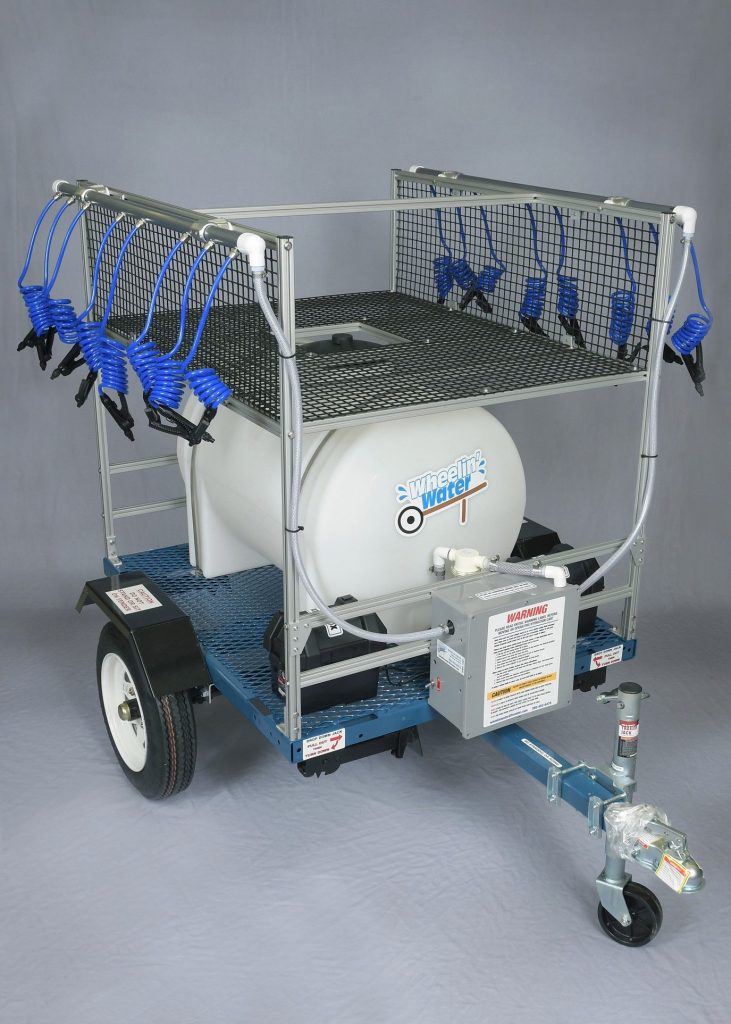
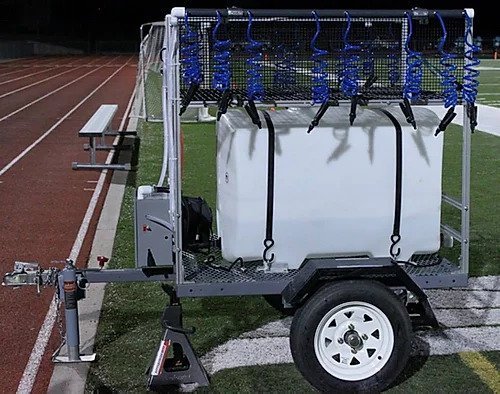
Larger mobile systems may be appropriate when a program needs greater water capacity or multiple dispensing positions.
The current Hydration & Cooling product range includes team water tankers in several capacities, allowing programs to evaluate equipment based on team size and operating requirements.
Combine Equipment When Appropriate
A program does not necessarily have to use one hydration unit for every situation.
A larger team system can serve as the primary water source while smaller mobile stations support secondary locations.
This approach may be useful when teams have:
- Large rosters
- Multiple practice areas
- Large tournament facilities
- Separate team areas
- Multiple simultaneous activities
Our Sideline Water Stations
-
50 Gallon Rechargeable Portable Water Wagon | 10 & 16 Hose Models – USA MADE!
$3,800.00 -
Best 65 Gallon Rechargeable Football Water Cow | Made In USA | New Low Price!
$5,090.00 -
Best Team Sports Hydration Station – Rechargeable 35 Gallon Tanker For 8 Players
Original price was: $2,790.00.$2,590.00Current price is: $2,590.00. -

Efficient 20 Player Team Practice Hydration Package | Our Hydration Station Combo
$3,390.00 -
Our #1 Game Day Package | Team Misting Fans Cooling Station + Hydration Tanker
Original price was: $5,750.00.$5,390.00Current price is: $5,390.00. -
Portable 35 Gallon Rechargeable Water Wagon | Made In USA!
$3,190.00 -
Super 100 Gallon Rechargeable Football Hydration Station | Made In USA & New Low Price!
$5,790.00



Planning Multiple Sideline Hydration Stations
Multiple stations can make sense when one location cannot provide convenient access for the entire team.
Before adding another station, evaluate:
Team Size
How many athletes may need access during the same break?
Sideline Length
A long sideline may make a single centralized station less practical.
Facility Layout
Different sports have different bench, field, court, dugout, and team-area configurations.
Equipment Mobility
If the same equipment is used for practice and games, choose systems that can be moved and stored efficiently.
Replenishment
Additional stations also mean additional equipment to fill, clean, inspect, and maintain.
The goal is not to maximize the number of hydration stations. The goal is to create a configuration that fits the program’s actual operations.
Game-Day Water Station Setup
A consistent setup process can make the hydration station easier for staff to manage.
Before the Game
Staff should:
- Inspect the hydration equipment
- Check dispensing components
- Confirm the system is clean
- Fill the system according to its capacity and operating requirements
- Prepare any necessary supplies
- Confirm the station’s location
- Check venue requirements
- Make sure the equipment does not interfere with sideline operations
For powered equipment, verify the applicable power or battery requirements before the event.
During the Game
Staff should monitor:
- Water availability
- Equipment condition
- Dispensing components
- Player traffic
- Station location
- Weather conditions
- Ice or cooling requirements, where applicable
If the sideline becomes crowded or the flow of players changes, the equipment may need to be repositioned during an appropriate break.
After the Game
After the event:
- Empty or service the system according to manufacturer instructions
- Clean the equipment
- Inspect for damage
- Store it appropriately
- Record maintenance issues that need attention before the next event
Cleaning and Maintaining Sideline Hydration Equipment
A sideline hydration station is only useful if it remains clean, functional, and ready for use.
Follow the manufacturer’s specific cleaning and maintenance instructions for each system.
Routine maintenance should include inspection of:
- Tanks
- Hoses
- Nozzles
- Caps
- Valves
- Seals
- Wheels
- Handles
- Pumps and power systems where applicable
The Hydration & Cooling Sports Cool system, for example, includes retractable drinking hoses, quick shut-off nozzles, a large-mouth tank opening, and a rechargeable power system. Those components should be included in the program’s equipment inspection and maintenance process.
Sideline Hydration Planning Checklist
Before each season, athletic departments can use the following checklist:
Facility
- Where is the team area?
- Where are the restricted areas?
- Where is active play taking place?
- What are the venue’s equipment-placement rules?
Athletes
- How many athletes need access?
- How many may need water simultaneously?
- Does the sport require specialized access?
Equipment
- What capacity is appropriate?
- How many dispensing positions are needed?
- Does the equipment need to move?
- Is a secondary station useful?
Operations
- Who fills the equipment?
- Who cleans it?
- Who moves it?
- Who checks it before games?
- Where is it stored?
Environment
- Is the station exposed to direct sunlight?
- Is weather protection needed?
- Are there water or power considerations?
- Does the equipment need to be moved between events?
A simple checklist can help athletic departments standardize hydration setup across multiple teams and facilities.
Frequently Asked Questions
Where should a sideline water station be placed?
Place the station near the team area where athletes can access it during appropriate breaks, while keeping it outside active play and away from areas that interfere with coaches, officials, equipment, and normal sideline traffic.
How many sideline water stations does a team need?
There is no universal number. The appropriate quantity depends on roster size, equipment capacity, dispensing positions, sideline length, facility layout, and how many athletes need access at the same time.
Should a water station be on the sideline or behind the bench?
Either arrangement can work depending on the sport and facility. The important considerations are accessibility, available space, player movement, staff access, and venue rules. Equipment should not interfere with active play or required sideline operations.
What equipment can be used for sideline hydration?
Options include portable water cooler carts, hydration station stands, powered team drinkers, football water stations, and larger team water tankers. Hydration & Cooling offers several of these equipment categories.
Are multiple hydration stations better than one large station?
Not necessarily. The appropriate configuration depends on the facility and team. Multiple smaller stations may distribute traffic more effectively, while one larger system may provide the capacity a centralized team area requires.
Can sideline hydration equipment be used for practice as well as games?
Yes. Mobile hydration equipment can be useful for both practices and competitions, particularly when teams use different areas of a facility or need to move hydration equipment between locations.
Conclusion
Strategic sideline water station placement starts with the way athletes, coaches, staff, and equipment actually move through a facility.
The right location should provide convenient access without interfering with active play or creating unnecessary congestion. Equipment capacity, dispensing access, mobility, storage, maintenance, and venue requirements should all be considered before establishing a permanent game-day setup.
For some programs, a compact water cooler cart or team hydration station may provide the appropriate solution. Larger programs may need a higher-capacity mobile hydration system or multiple hydration points. Hydration & Cooling offers both smaller water cooler systems and larger team hydration equipment for athletic programs.
The most effective sideline setup is the one that fits the facility, the team, and the program’s day-to-day operating requirements.
Need Help Choosing the Right Hydration System?
Hydration & Cooling has more than 25 years of experience helping coaches, athletic directors, schools, teams, equipment managers, and organizations select hydration and cooling equipment appropriate to their needs and budget.
828-820-8600
Monday–Friday, 10 AM–5 PM EST