
The Big Picture
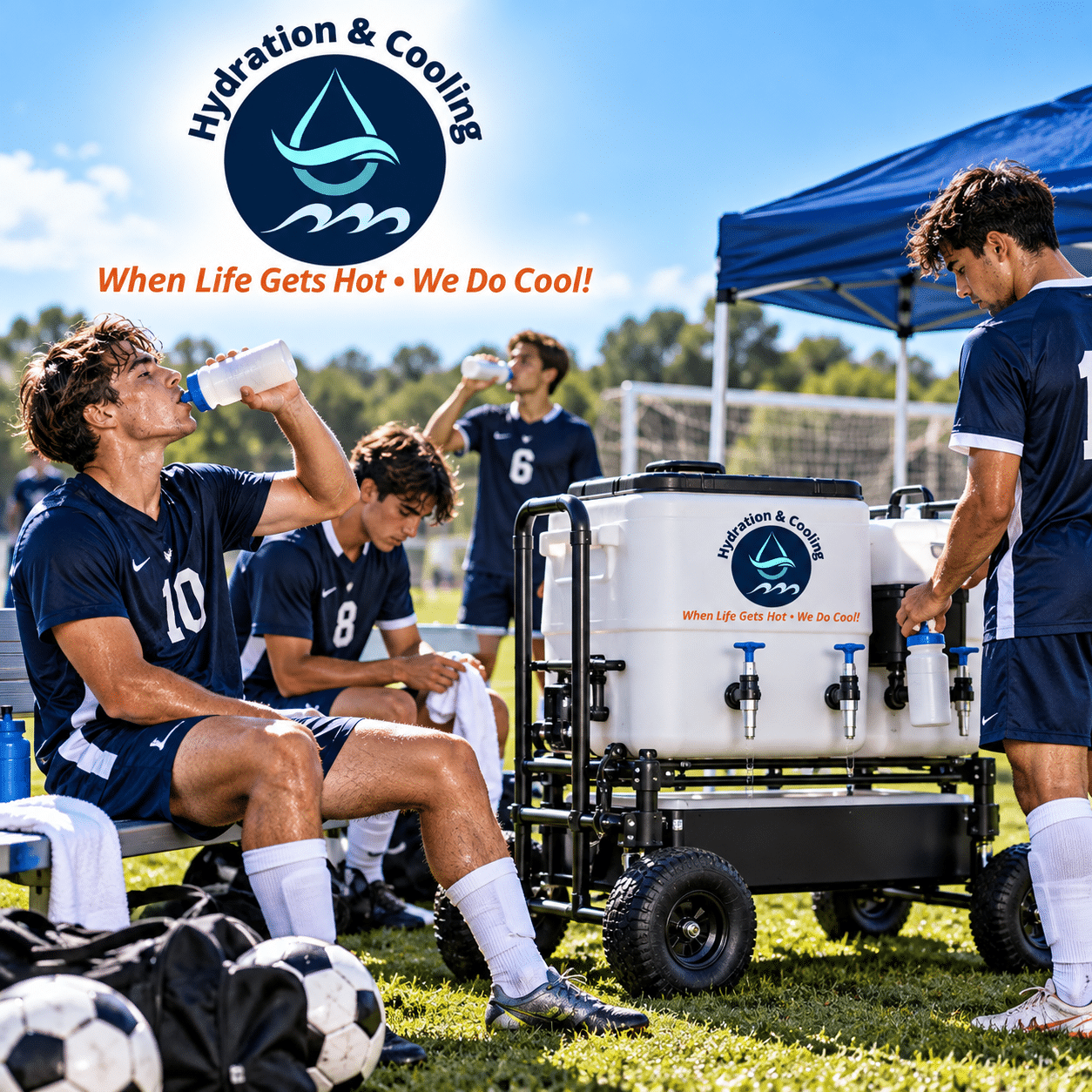
Men’s soccer hydration and cooling equipment should be selected around the way a soccer program actually operates: full-field training, repeated drills, preseason conditioning, match-day sidelines, away games, and multi-field tournaments.
Unlike a permanent drinking fountain or a cooler left outside the locker room, a portable soccer hydration system brings water closer to the athletes who need access during scheduled breaks. Mobile water carts, rechargeable water wagons, and rolling cooler stations can help coaches and equipment managers organize that access without depending entirely on fixed facilities.
Cooling equipment serves a different but complementary purpose. Portable misting fans can support designated sideline or rest areas during hot-weather activities, provided the equipment is appropriate for the location and used according to manufacturer instructions.
For high school, college, and competitive club men’s soccer programs, the objective is straightforward: choose equipment that matches the roster, the field, the schedule, and the staff responsible for operating it.
Key Insight
The best men’s soccer hydration setup is not necessarily the largest water tank. It is the system that provides accessible water, practical mobility, sufficient dispensing capacity, and a dependable replenishment plan.
A 20-gallon mobile hydration cart may suit a particular practice arrangement, while a 35- or 50-gallon water wagon may better serve a larger squad, a remote field, or a longer event. Programs using multiple practice areas may benefit from more than one smaller station rather than concentrating every player around a single location.
Cooling equipment should be planned separately, based on weather conditions, available power, space, and the athletic department’s established heat-safety procedures.
What Matters Most
When comparing soccer hydration equipment, focus on six operational questions:
- Roster and users: How many players, substitutes, coaches, and staff need access?
- Field layout: How far is the equipment from training areas and team benches?
- Water capacity: How much usable water is needed between planned refills?
- Dispensing access: Can players obtain water efficiently during scheduled breaks?
- Mobility: Can staff move the equipment across grass, turf, gates, and storage areas?
- Cooling support: Is there an appropriate location for a misting fan or other designated cooling equipment?
A useful purchase decision considers all six rather than tank capacity alone.
Table of Contents
Why Men’s Soccer Needs a Dedicated Hydration and Cooling Equipment Plan
Men’s soccer presents equipment-management challenges that differ from those of sports using smaller playing areas or fixed sideline stations.
Players may move between warm-up zones, conditioning areas, full-field drills, and recovery spaces. Coaches may divide a squad into multiple training groups, while athletic trainers and equipment staff need access to water and supplies throughout the session.
During matches, equipment must fit within the venue’s permitted team areas without obstructing officials, substitutes, or field access. At tournaments, a team may need to move its equipment between fields or rely on facilities it does not control.
Hydration access during soccer training
A soccer practice may involve technical drills, tactical work, conditioning, and scrimmages. Hydration equipment should be placed where athletes can access it during the breaks established by the coaching and athletic training staff.
If all drinking water is located far from the practice area, the program may face unnecessary equipment movement and repeated trips across the facility.
Portable systems give staff greater flexibility when the team changes fields or reorganizes its training layout.
Equipment planning versus individual hydration guidance
Hydration & Cooling supplies equipment for organized water access. Individual fluid needs, hydration schedules, and activity modifications should be determined by qualified athletic training or medical personnel under the program’s established procedures.
Equipment planning supports those procedures; it does not replace them.
Types of Men’s Soccer Hydration Equipment
Not every men’s soccer program needs the same combination of water carts, tankers, and cooling equipment.
The most useful starting point is to understand the differences between available equipment categories.
Rolling soccer water cooler carts
A rolling cooler cart is a straightforward option for programs using conventional insulated water coolers.
These carts can make it easier to transport a filled cooler from a storage room to a practice field or match-day team area. They can also provide space for cups or other supplies, depending on the model.
Hydration & Cooling offers a rolling water cooler cart with optional 5- or 10-gallon cooler, a product specifically described as useful for soccer and football sidelines.
Rolling cooler carts are worth considering when a program wants portable water access without purchasing a larger powered dispensing system.
Recommended product
-

Rolling Water Cooler Cart & Optional 5 + 10 Gallon Igloo Cooler
Price range: $490.00 through $595.00
Rechargeable 10- and 20-gallon hydration carts
Rechargeable hydration carts provide a different approach to team water distribution.
Hydration & Cooling’s 10- and 20-gallon hydration carts use rechargeable pumps and multiple drinking nozzles.
The 10-gallon model has four drinking nozzles, while the 20-gallon model has six. Both feature aluminum frames, flat-free tires, and tanks designed for filling and cleaning.
For men’s soccer programs, these carts may be useful when equipment must move between training locations or when staff prefer multiple accessible stations.
Recommended products
-
Small Hydration Carts | USA-Made 10 & 20 Gallon Models | New Low Price!
Price range: $1,890.00 through $2,180.00

Portable 35- to 50-gallon soccer water wagons
Larger rechargeable water wagons provide greater onboard capacity and may reduce the frequency of refilling during longer activities.
A 35-gallon system can be considered for a team requiring a central mobile station, while a 50-gallon system may suit a program with additional water demands, longer operating periods, or limited refill access.
The appropriate choice depends on actual consumption, refill opportunities, and the number of athletes using the equipment.
Hydration & Cooling’s portable hydration systems include rechargeable water wagons in these capacity ranges.
Recommended products


Larger team hydration systems
Some athletic departments manage several teams, practice sessions, or fields using shared equipment.
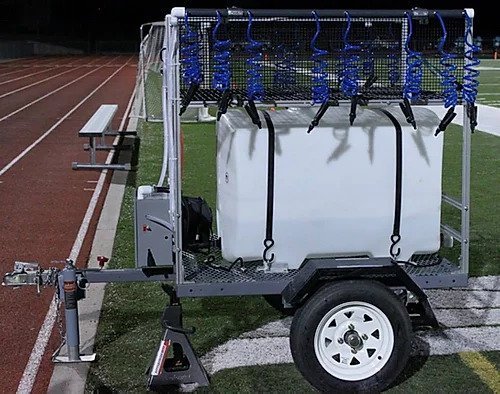
In these settings, larger water tankers may have a role, particularly when the equipment can be moved safely and replenished efficiently.
However, a high-capacity tank does not automatically solve access problems if it is positioned too far from players or serves too many activity areas.
A program should consider whether one larger station or several smaller stations will be more practical.
Recommended products

Choosing Water Capacity for Your Men’s Soccer Program
Water capacity is one of the most important equipment specifications, but it should not be selected from roster size alone.
Two teams with similar numbers of players may have very different equipment requirements because of practice duration, weather, facility layout, refill access, and event schedules.
Start with the complete user group
Account for everyone who will use the station, including active players, substitutes, coaches, and relevant support staff.
Then consider whether the equipment must serve one training session or multiple sessions before refilling.
Identify replenishment opportunities
A practice field near a reliable potable water source creates a different operational situation from an off-campus facility with no convenient refill location.
The less convenient the replenishment process, the more important it becomes to evaluate onboard water capacity and backup supplies.
Compare capacity and dispensing points
Tank size describes how much water the equipment holds. Dispensing capacity describes how many people can access it at once.
These are different purchasing considerations.
A system with more drinking points may help staff organize a short team break, while a larger tank may be useful when refilling is difficult.
Men’s soccer equipment comparison
| Equipment | Practical use case | Primary consideration |
|---|---|---|
| Rolling cooler cart | Smaller team areas and away matches | Cooler size and transport |
| 10-gallon hydration cart | Individual training areas or supplemental access | Compact mobility |
| 20-gallon hydration cart | Team practices and mobile stations | Multiple drinking points |
| 35-gallon water wagon | Central practice or sideline station | Capacity and refill access |
| 50-gallon water wagon | Longer sessions or larger operational needs | Transport and replenishment |
| Portable misting fan | Designated cooling area | Power, water, and safe placement |
These are equipment-planning examples, not prescribed capacities for a particular roster or duration.
Practice Field Hydration Setup for Men’s Soccer
Practice field organization can affect how conveniently players and staff access hydration equipment.
A well-planned setup begins before athletes arrive.
Position water near established break areas
Locate hydration equipment near the areas where coaches and athletic trainers expect players to gather.
Avoid placing carts or hoses where they create obstructions along running lanes, technical drills, or equipment routes.
The station should be accessible without requiring players to cross active drills unnecessarily.
Plan for multiple training groups
A men’s soccer squad may train in separate groups for goalkeeper work, technical drills, conditioning, or tactical sessions.
If those groups are spread across a large facility, a single central water station may not be convenient.
Depending on equipment availability, staff can use smaller mobile stations or reposition equipment between activities.
Account for grass and artificial turf
Mobility requirements vary by facility.
Equipment managers should consider tire design, loaded weight, access gates, permitted travel routes, and any restrictions imposed by the facility.
A cart that moves easily through a storage corridor may be harder to reposition when fully loaded on uneven ground.
Assign a staff member to equipment readiness
Before practice, a designated person should verify that the equipment is filled, clean, operational, and positioned correctly.
For powered carts, this also includes checking the battery and pump.
That preparation reduces last-minute disruptions and helps ensure the equipment is ready when the session begins.
Match-Day Sideline Hydration and Cooling
A men’s soccer match requires a more controlled equipment arrangement than a typical training session.
The team must work within venue requirements, competition rules, and the permitted technical or bench areas.
Keep hydration equipment accessible to substitutes and staff
Players on the bench and staff members need convenient access to water throughout the match.
Equipment placement should also support players returning to the team area during permitted breaks and at halftime.
The precise location must be coordinated with the venue and match-day personnel.
Prepare for halftime demand
Halftime may create a concentrated period of water access, equipment movement, and staff activity.
A system with multiple dispensing points can help organize this process, provided its location and use are appropriate for the team area.
Staff should confirm water levels before the match and identify any replenishment that may be needed before halftime.
Keep sideline pathways clear
Portable water wagons and cooling fans must not obstruct officials, player movement, emergency access, or equipment routes.
Before kickoff, confirm that hoses, power cords, wheels, and other components are secured and appropriately positioned.
Coordinate cooling resources
During warm-weather matches, a designated cooling location may be appropriate under the team’s established heat-safety plan.
Misting equipment should be positioned where it can operate without interfering with competition or creating unsafe conditions.
Men’s Soccer Tournament and Away-Game Equipment Planning
Tournaments create additional challenges because the team may spend many hours at a venue and move between different fields.
A system that works well at the home training facility may not be practical for every away-game situation.
Evaluate transport before purchasing
Ask whether the equipment fits the vehicle or trailer normally used by the program.
Check its dimensions, weight, loading requirements, and whether staff can move it safely when empty and filled.
A smaller hydration cart or rolling cooler may be more convenient for certain travel arrangements than a larger tanker.
Confirm venue resources
Before departure, identify the water sources, available electrical outlets, permitted equipment locations, and any venue restrictions.
Do not assume that an away facility will provide the same access as the home field.
Prepare for multiple matches or extended attendance
The equipment plan should cover the full event, including warm-ups, scheduled matches, time between games, and post-match activities.
Staff should also know where equipment will be stored and how it will be cleaned and transported afterward.
Maintain a backup plan
A program relying on one powered hydration system should consider what happens if the battery, pump, or another component becomes unavailable.
Depending on the program, a conventional cooler or additional mobile station may provide useful redundancy.
Men’s Soccer Cooling Equipment for Hot-Weather Activities
Hydration equipment supplies drinking water. Cooling equipment supports designated areas where athletes and staff may seek relief from hot conditions.
These functions complement one another, but they should not be treated as interchangeable.
Portable misting fans for soccer sidelines
A portable misting fan can be useful where a program has appropriate space, electrical access, and water supply.
Hydration & Cooling’s 24-inch portable misting fan has a self-contained 20-gallon water tank and operates using a 115-volt electrical connection.
Its rolling design may be practical for certain athletic field environments.
Actual cooling performance depends on environmental conditions, placement, and operating requirements.

Choosing a cooling location
Staff should evaluate the distance from team areas, access to electricity, safe cord routing, water replenishment, and whether the fan will affect nearby people or equipment.
Misting systems must also be used in accordance with venue restrictions and manufacturer guidance.
Cooling equipment is not emergency treatment
Portable misting fans are not a substitute for approved heat-illness emergency procedures, appropriate medical evaluation, or rapid cooling methods required by an institution’s emergency action plan.
Athletic trainers and qualified personnel should direct medical and heat-safety decisions.
Equipment Selection by Men’s Soccer Program Level
Different men’s soccer programs may benefit from different equipment configurations.
High school boys’ soccer
High school programs often need equipment that can serve practices, home matches, and shared athletic facilities.
Important considerations include storage, ease of operation, transport between fields, and the availability of staff responsible for setup and maintenance.
A rolling cooler cart or mobile hydration cart may be a practical starting point, with larger systems considered when operational needs justify them.
NCAA and college men’s soccer
College programs may manage larger training facilities, separate practice and competition venues, travel schedules, and shared sports medicine resources.
Equipment selection should account for the actual training environment, staff workflows, and any institutional purchasing or operating requirements.
Rechargeable water wagons and multiple hydration stations may be useful where teams train across separate areas.
Men’s club and academy soccer
Club and academy programs may operate at complexes with several fields and overlapping team schedules.
Mobility and shared-equipment planning can be especially important.
A program may benefit from standardized carts and a documented assignment process so staff know which equipment is available for each session.
Professional men’s soccer
Professional clubs may have dedicated training facilities and more extensive operational support.
Even so, practical questions remain the same: where water is needed, how equipment is replenished, how quickly it can be repositioned, and who is responsible for maintaining it.
Equipment should be evaluated against the club’s actual facilities and performance-support procedures rather than assumptions about professional requirements.
Maintenance, Storage, and Staff Responsibilities
Reliable men’s soccer hydration equipment requires routine attention before and after use.
Before each session
Check that tanks and dispensing components are clean, water is supplied from an appropriate source, pumps and batteries are functioning, and equipment can be moved and operated safely.
For cooling equipment, verify that water and electrical requirements are met.
After each session
Follow the manufacturer’s instructions for draining, cleaning, sanitizing, drying, and storing the equipment.
Inspect hoses, nozzles, connections, wheels, and other components for damage or wear.
Between events
Confirm that the equipment is ready for the next scheduled use, particularly when multiple teams share the same system.
A written maintenance and assignment process can help prevent confusion when equipment moves between sports or facilities.
Building a Men’s Soccer Hydration and Cooling Equipment Plan
The most useful equipment plan is one that staff can repeat throughout the season.
Start by documenting the number of athletes, field locations, practice schedule, match-day requirements, travel arrangements, and available water and power sources.
Next, identify where portable hydration stations are needed and whether a rolling cooler, rechargeable cart, or larger water wagon best suits each location.
Then evaluate cooling equipment separately, based on the team’s established hot-weather procedures and the practical requirements of the venue.
Finally, assign responsibility for filling, transporting, operating, cleaning, and storing every piece of equipment.
Men’s Soccer Equipment Planning Checklist
- Confirm roster and staff access requirements.
- Identify practice and match-day hydration locations.
- Evaluate tank capacity and refill opportunities.
- Check dispensing points and equipment mobility.
- Confirm away-game transport requirements.
- Evaluate cooling equipment placement and power.
- Assign setup, inspection, cleaning, and storage duties.
- Establish a backup plan for equipment problems.
A well-organized plan helps coaches and equipment managers support the soccer program without treating hydration equipment as a last-minute match-day task.
Frequently Asked Questions
1. What hydration equipment is best for a men’s soccer team?
The best equipment depends on the roster, field layout, practice schedule, and refill access. Rolling cooler carts may work for smaller or travel-based setups, while rechargeable hydration carts and larger water wagons can support programs needing more capacity or multiple dispensing points.
2. Can football water wagons be used for men’s soccer?
Yes. Many portable team hydration systems are suitable for multiple outdoor sports. A water wagon marketed for football may also be appropriate for soccer if its capacity, dimensions, mobility, and operating requirements fit the soccer program.
3. What size water wagon does a men’s soccer team need?
There is no single correct tank size for every team. Staff should consider the number of users, session duration, environmental conditions, access to refills, and actual water use. Individual hydration requirements should be established by qualified personnel.
4. Where should a soccer hydration station be placed during practice?
Place the station near designated break areas where athletes can access it without interfering with drills or field operations. The location should also allow safe equipment movement and convenient replenishment.
5. Are portable misting fans useful for men’s soccer?
Portable misting fans can support designated sideline or rest areas when conditions and venue requirements permit. They require suitable placement, water, and—in the case of many models—electrical power. They do not replace approved heat-safety procedures.
6. What hydration equipment should men’s soccer teams take to away games?
Equipment choices depend on available transportation and venue facilities. Rolling cooler carts and compact hydration carts may be easier to transport, while larger mobile systems can be considered when the team has suitable loading arrangements and operational needs.
7. How should men’s soccer hydration equipment be maintained?
Follow the manufacturer’s instructions for cleaning, sanitizing, inspection, charging, draining, and storage. Assign staff responsibility and check the equipment before each use, especially when multiple teams share it.
Conclusion: Equip Your Men’s Soccer Program for the Full Season
Men’s soccer hydration and cooling equipment should support more than one practice or match. The right setup must work across training sessions, home competitions, away games, and tournaments.
By selecting suitable water capacity, mobile dispensing equipment, and appropriately placed cooling resources, athletic departments can build a more consistent equipment-management process.
Hydration & Cooling offers portable water carts, rechargeable hydration systems, water wagons, and outdoor misting fans for athletic programs.
With more than 25 years of industry experience, we can help you compare equipment options for your men’s soccer facilities and operating requirements.
Call 828-820-8600, Monday–Friday, 10 AM–5 PM Eastern, to discuss your men’s soccer hydration and cooling equipment needs.
When Life Gets Hot • We Do Cool!