
The Big Picture
Choosing a football water tanker involves more than selecting the largest tank your athletic department can afford. The right equipment must match your roster, practice schedule, field layout, refill access, transportation requirements, and the number of players who need convenient access to water.
Football programs use several names for this equipment, including water tankers, water cows, water buffaloes, and water wagons. These terms generally describe portable, high-capacity water systems designed to supply drinking water at athletic fields and sidelines.
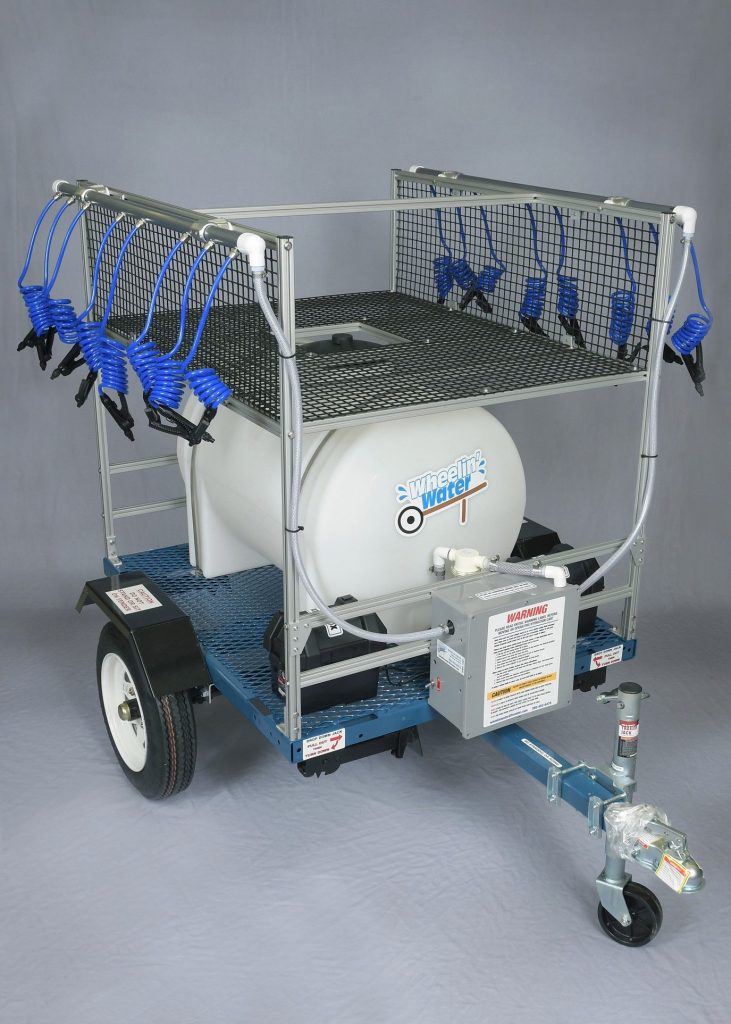
However, not every football water tanker offers the same configuration. Tank capacities, dispensing positions, rechargeable pumps, frames, wheels, and transport requirements vary between models.
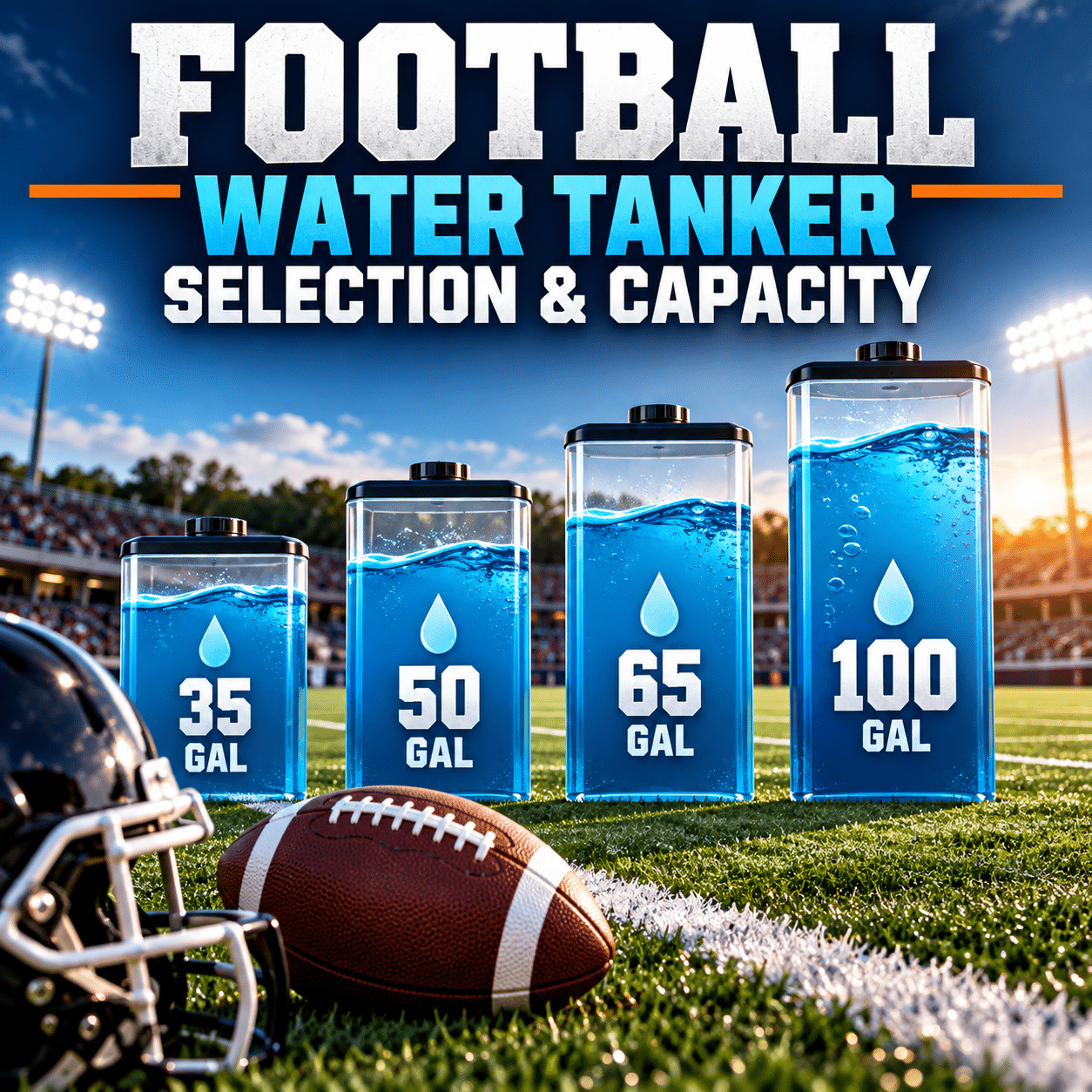
A 35-gallon unit may be a practical choice for a program that values mobility and convenient refilling. A 65-gallon water cow may better suit a larger operation with centralized water access. A 100-gallon tanker may offer useful additional storage capacity, provided the facility can accommodate its filled weight and transportation requirements.
The best football water tanker is the one that matches how your program actually operates.
This guide explains how to evaluate tanker capacity, dispensing configuration, mobility, rechargeable power, maintenance access, and long-term equipment value before making a purchase.
Key Insight
Football water tanker selection should be based on usable capacity, player access, and refill logistics—not roster size alone.
A larger tank provides more stored water, but it does not automatically provide more drinking positions, easier transportation, or better access across multiple practice fields.
Start by determining where the tanker will operate, how it will be filled, how many players need access at the same time, and whether one large unit or several smaller stations better supports the program.
What Matters Most
- Tank capacity: Choose a water volume that fits your operating schedule and available refill opportunities.
- Dispensing capacity: Compare the number of drinking hoses or nozzles independently from tank size.
- Mobility: Evaluate wheels, frame design, equipment dimensions, terrain, and filled weight.
- Power: Determine whether a rechargeable pump is appropriate for locations without convenient electrical access.
- Field layout: Consider whether a central tanker can serve the program or whether distributed stations are more practical.
- Maintenance: Look for accessible tanks, serviceable components, and manageable cleaning requirements.
- Budget: Compare useful features, equipment durability, and operational fit—not simply gallons per dollar.
Table of Contents
What Is a Football Water Tanker?
A football water tanker is a portable water-storage and dispensing system designed for team use at practices, games, and other athletic activities.
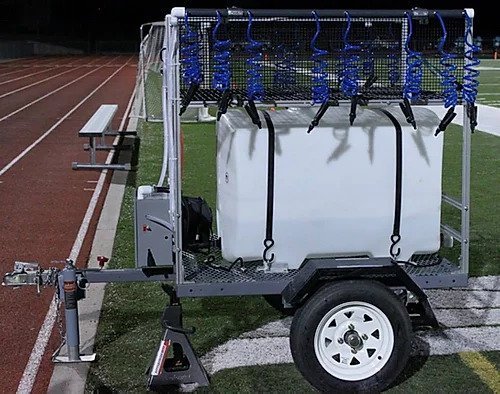
Unlike a conventional drinking-water cooler, a team tanker typically combines a larger water reservoir with a mobile frame and equipment for distributing water to multiple users.
Depending on the model, a football water tanker may include:
- A water-storage tank.
- A wheeled frame or transport platform.
- Multiple drinking hoses or dispensing nozzles.
- A pump and rechargeable battery.
- Filling and draining access.
- Components designed for cleaning and routine maintenance.
These features allow equipment managers to bring a substantial water supply closer to the athletes who need it.
Water Tanker, Water Cow, Water Buffalo, or Water Wagon?
These names are often used interchangeably in sports equipment discussions.
The terminology matters less than the actual equipment specifications.
When comparing models, verify tank capacity, the number of dispensing positions, power requirements, mobility features, dimensions, and manufacturer operating instructions.
Two products described as football water cows may differ significantly in how they are transported, operated, and maintained.
Our Water Tankers
-
50 Gallon Rechargeable Portable Water Wagon | 10 & 16 Hose Models – USA MADE!
$3,800.00 -
Best 65 Gallon Rechargeable Football Water Cow | Made In USA | New Low Price!
$5,090.00 -
Best Team Sports Hydration Station – Rechargeable 35 Gallon Tanker For 8 Players
Original price was: $2,790.00.$2,590.00Current price is: $2,590.00. -

Efficient 20 Player Team Practice Hydration Package | Our Hydration Station Combo
$3,390.00 -
Our #1 Game Day Package | Team Misting Fans Cooling Station + Hydration Tanker
Original price was: $5,750.00.$5,390.00Current price is: $5,390.00. -
Portable 35 Gallon Rechargeable Water Wagon | Made In USA!
$3,190.00 -
Super 100 Gallon Rechargeable Football Hydration Station | Made In USA & New Low Price!
$5,790.00



Understanding Football Water Tanker Capacity
Tank capacity describes the amount of water a unit can store. It does not, by itself, tell you how many players can use the equipment at once or how long the supply will last.
A 65-gallon water tanker holds more water than a 35-gallon model, but actual refill requirements depend on the team’s use of the equipment.
Important variables include roster size, session duration, weather, established hydration procedures, and access to additional drinking water.
Stored Water vs. Dispensing Access
These are two separate buying considerations.
Stored water capacity determines how much water the unit can carry between refills.
Dispensing capacity describes how many drinking positions the unit provides and how the water is delivered.
A larger tank with relatively few drinking positions may be useful for a team with staggered access. A smaller tank with multiple dispensing positions may be more convenient for a position group that gathers at one location.
Neither configuration is universally better.
Why Refilling Changes the Capacity Decision
A program with a nearby drinking-water source may be comfortable using a smaller tanker and refilling it as needed.
A facility with remote practice fields or restricted water access may place greater value on carrying additional water from the start.
Before choosing a capacity, ask how far the tanker must travel to be refilled, who will move it, and whether refilling can occur without disrupting the equipment operation.
Comparing 35-, 50-, 65-, and 100-Gallon Water Tankers
Hydration & Cooling offers football-oriented tanker options across several capacity classes. Each size addresses a different combination of water storage, portability, and operating requirements.
35-Gallon Football Water Tankers
A 35-gallon tanker can be a useful starting point for programs that need more capacity than a small hydration cart without moving to the largest available equipment.
Potential applications include individual practice fields, position-group operations, smaller football programs, and facilities with convenient refill access.
When evaluating a 35-gallon model, consider its drinking positions, frame dimensions, and whether the available pump and battery configuration fits the intended use.
A smaller tank may also be easier to accommodate in facilities with narrow access routes or limited storage space.
50-Gallon Football Water Tankers
The 50-gallon class offers additional water storage while remaining an alternative to larger 65- and 100-gallon systems.
This capacity may appeal to programs looking for a central mobile water supply without selecting the highest-capacity tanker.
Some configurations offer different numbers of drinking hoses, making it important to compare the actual dispensing arrangement rather than focusing only on the tank volume.
The right 50-gallon model depends on where it will operate and how the team intends to use its dispensing stations.
Recommended products
65-Gallon Football Water Cows
A 65-gallon football water cow provides greater stored capacity for programs that want a substantial central water supply.
This class may suit larger high school programs, college position-group operations, or facilities where the water station remains in a relatively consistent location during practice.
However, added capacity also means additional water weight.
Before purchasing, verify that the equipment can travel along the intended routes and that staff have an appropriate way to transport and position it.
Recommended products
100-Gallon Football Water Tankers
A 100-gallon football water tanker is a high-capacity option for programs that need a substantial amount of water available at a central location.
Potential applications include large football operations, multi-team facilities, and practice environments where refilling is inconvenient.
Its greater storage capacity may reduce the need for frequent refill trips, depending on actual usage.
The tradeoffs include filled weight, maneuvering requirements, storage footprint, and transportation logistics.
A 100-gallon tanker should be selected because the program needs its capacity—not simply because it is the largest option.
Recommended products
How to Choose the Right Tanker Capacity
A practical selection process begins with the way the team uses water equipment during a normal football session.
Step 1: Identify the Primary Use
Will the tanker serve daily practice, home games, remote fields, training camp, or multiple activities?
A unit that remains near one practice field has different requirements from equipment that must be loaded, transported, and repositioned frequently.
Determine the primary application before comparing models.
Step 2: Review Roster and Practice Organization
Roster size matters, but so does the way players are grouped.
A program with several position groups working on separate fields may need distributed access. A program using one central practice area may find a larger tanker more convenient.
Consider how players reach the station, not just how many names appear on the roster.
Step 3: Evaluate Refill Opportunities
Identify the available drinking-water source, distance to the field, and practical refill procedure.
Programs with reliable refill access have more flexibility when considering smaller capacities.
Programs operating far from a water connection may benefit from additional stored capacity.
Step 4: Consider the Entire Session
Account for the length of the activity, the team’s established hydration procedures, anticipated conditions, and whether additional water stations will be available.
For a detailed assessment of total water requirements, the related resource How Much Water Does a Football Team Need? addresses capacity planning more broadly.
Avoid selecting a tanker using a universal gallons-per-player assumption. Actual needs and appropriate hydration procedures vary.
Step 5: Verify Equipment Specifications
Once the operational requirements are clear, compare specific models.
Confirm the listed capacity, drinking positions, pump configuration, battery requirements, physical dimensions, filled-weight considerations, and maintenance instructions.
These details turn a general capacity preference into an informed equipment decision.
Drinking Stations, Hoses, and Player Access
A football water tanker must do more than store water. It must make that water practical to access.
The number and arrangement of drinking positions can affect how the equipment fits into a football program.
Number of Dispensing Positions
Some tanker configurations offer more drinking hoses or nozzles than others.
Compare the actual number of simultaneous dispensing positions provided by each model.
Do not assume that a larger tank automatically includes more drinking stations.
A program with large groups gathering at the same time may value additional access points, while a program with staggered player access may have different priorities.
Hose Reach and Station Layout
Evaluate how the hoses are arranged and whether players can use them conveniently from the intended station location.
Consider the space around the tanker, the position of the frame, and the movement of players and staff.
A well-chosen unit should fit the available field space without creating unnecessary congestion.
Dispensing Equipment and Serviceability
Look at how the pump, hoses, nozzles, and connections are maintained.
Equipment managers should be able to inspect the system and follow manufacturer cleaning and servicing instructions without unnecessary complications.
Serviceability deserves attention before the purchase, not only after a component needs replacement.
Rechargeable vs. Other Water Tanker Configurations
Rechargeable football water tankers use battery-powered equipment to operate their dispensing systems.
These configurations can be especially useful when a team needs powered water distribution at a location without a convenient electrical outlet.
What a Rechargeable System Does
A rechargeable system typically uses a battery to power a pump that delivers water through the dispensing equipment.
This allows the tanker to operate without a continuous connection to external electrical power, subject to its battery charge and operating specifications.
A rechargeable pump does not necessarily mean the system refrigerates its water.
Water cooling and powered dispensing are different functions. Buyers should verify whether a particular model includes active refrigeration, insulation, or neither.
Questions to Ask About Battery Operation
Before purchasing a rechargeable football water buffalo, confirm:
- What components are battery-powered?
- What battery and charger are supplied?
- How is the unit recharged?
- What operating duration does the manufacturer specify?
- What maintenance or replacement requirements apply?
- Where will the equipment be stored and charged?
Battery performance should be evaluated using the actual product specifications rather than a general runtime promise.
When a Rechargeable Tanker Makes Sense
Rechargeable systems may be a strong fit for remote fields, changing practice locations, and facilities without conveniently located electrical service.
They also require staff to manage charging and battery readiness as part of the equipment routine.
For programs with reliable fixed water connections, other dispensing arrangements may also deserve consideration.
Mobility, Weight, and Field Transportation
Mobility is one of the most important differences between tanker configurations.
A unit may be described as portable, but moving it while filled can be very different from moving it empty.
Understand the Weight of Stored Water
Water weighs approximately 8.34 pounds per U.S. gallon.
That means the water alone contributes approximately:
| Tank capacity | Water weight when full |
|---|---|
| 35 gallons | 292 lb |
| 50 gallons | 417 lb |
| 65 gallons | 542 lb |
| 100 gallons | 834 lb |
These figures exclude the tank, frame, battery, wheels, hoses, and other components.
The actual filled equipment weight will therefore be higher.
Evaluate the Route to the Field
Consider every surface and access point between equipment storage, filling, and deployment.
Grass, turf, gravel, slopes, narrow gates, and loading areas may affect the suitability of a particular model.
Check the manufacturer’s movement and towing instructions, where applicable, rather than assuming any water tanker can be moved safely by hand when full.
Storage and Transportation Dimensions
Confirm that the equipment fits through required gates and doors and can be accommodated in the available storage area.
For away games or off-site use, verify the transport vehicle’s capacity and the equipment’s loading and securement requirements.
A model that works well on the home practice field may not be practical for regular team travel.
One Large Water Cow vs. Multiple Smaller Units
One of the most important decisions is whether to purchase a single high-capacity tanker or distribute water access across several smaller units.
When One Large Tanker Makes Sense
A central tanker may be practical when the team uses a common practice area, water access is concentrated in one location, and staff can manage refilling and transportation efficiently.
A larger unit can provide substantial stored capacity without requiring multiple independent tanks.
However, all players must still be able to reach the equipment conveniently.
When Multiple Smaller Units Make Sense
Several smaller units may be preferable when position groups practice far apart, field access is restricted, or equipment must move frequently.
Distributed equipment can put water closer to different activity areas.
The tradeoff is that staff must monitor, refill, clean, transport, and store more than one unit.
When a Hybrid Arrangement Works
Some programs may prefer one primary tanker supported by smaller hydration carts or water coolers.
The tanker provides the central water supply, while the additional equipment supports access in separate locations.
This arrangement can be especially useful when practice fields and sideline requirements change throughout the season.
The broader guide How to Build a Football Hydration System explains how water supply, distribution, and player access work together across an entire facility.
Cleaning, Maintenance, and Storage Considerations
Maintenance requirements should be part of the buying decision because equipment managers will work with the tanker throughout the season.
Tank Access and Cleaning
Look for a tank opening that provides practical access for cleaning according to manufacturer instructions.
Also evaluate how hoses, nozzles, and other water-contact components are serviced.
Cleaning and sanitizing procedures should follow the manufacturer’s directions and applicable facility requirements.
Pumps, Batteries, and Replacement Components
Rechargeable units introduce components that may require periodic inspection, charging, maintenance, or replacement.
Ask about the availability of compatible hoses, nozzles, batteries, chargers, and other service parts.
The ability to obtain replacement components can be an important ownership consideration.
Off-Season Storage
Before purchase, identify where the tanker will be stored and whether the space provides appropriate protection from weather and freezing conditions.
Follow manufacturer instructions for draining, cleaning, battery care, and preparing the equipment for extended storage.
A suitable storage location is part of owning the equipment—not an afterthought.
Football Water Tanker Selection by Program Type
Different football programs may arrive at different equipment choices even when their rosters are similar.
Smaller High School Programs
Smaller programs may prioritize manageable dimensions, straightforward setup, and equipment that can be operated by a limited staff.
A 35-gallon tanker or smaller hydration cart may be worth evaluating when refill access is convenient.
The final choice should still account for roster requirements and session duration.
Larger High School Programs
Larger programs may benefit from comparing 50- and 65-gallon water cows with smaller supplemental stations.
The main questions are whether the team practices centrally, how far players travel for water, and whether the tanker can be refilled conveniently.
A 100-gallon option may also be appropriate where additional storage capacity is needed and transportation requirements can be met.
College and Multi-Field Football Programs
College and other large football operations may have multiple practice areas, separate position groups, and more complex equipment schedules.
These programs should evaluate both total water capacity and the number of locations that require access.
One high-capacity tanker may serve as a primary supply point, while additional carts or stations support distributed use.
Programs Sharing Equipment Across Sports
Schools that use the same equipment for football, soccer, lacrosse, and other field sports should consider how the tanker will operate throughout the athletic calendar.
Storage, transportation, field access, and staffing requirements may vary by sport.
Selecting equipment that accommodates multiple programs can improve its practical usefulness.
Common Water Tanker Buying Mistakes
Buying the Largest Tank Without Evaluating Mobility
Additional gallons are useful only if the equipment can be filled, transported, positioned, and maintained within the facility’s operating requirements.
Assuming Tank Capacity Equals Player Capacity
A 100-gallon tank does not automatically offer more drinking positions than a smaller model.
Compare storage volume and dispensing configuration separately.
Overlooking the Refill Location
A tanker with adequate storage capacity still needs a practical filling procedure.
Verify water-source access before choosing equipment.
Ignoring Filled Weight
The weight of the stored water can be substantial.
Review the manufacturer’s transport instructions and the suitability of the intended travel route.
Confusing Rechargeable Dispensing With Refrigeration
A rechargeable battery may power the pump without actively chilling the water.
Verify the actual product features.
Forgetting Cleaning and Storage
Tank access, removable components, battery care, and available storage space all affect everyday ownership.
Buying Without Comparing the Full Configuration
Two water cows with similar tank capacities may differ in dispensing positions, frame design, mobility, and power systems.
Compare the complete equipment specification before making a decision.
Frequently Asked Questions
What is the difference between a football water tanker and a water cow?
Football water tanker, water cow, water buffalo, and water wagon are commonly used names for portable team water-storage and dispensing equipment. The actual differences between products depend on tank capacity, dispensing configuration, mobility, and power features.
What size water tanker does a football team need?
The appropriate tanker size depends on roster size, session duration, practice layout, established hydration procedures, and refill access. Programs should compare these requirements before choosing among 35-, 50-, 65-, and 100-gallon options.
Is a 35-gallon water tanker large enough for a football team?
A 35-gallon tanker may be suitable for some football operations, particularly where refill access is convenient or additional water stations are available. Its suitability depends on the team’s actual water requirements and how the equipment will be used.
Should a football program choose a 65-gallon or 100-gallon water cow?
A 65-gallon water cow may offer a practical balance of storage capacity and mobility for some programs. A 100-gallon tanker provides more stored water but also introduces greater filled-weight and transportation considerations. The choice should follow the facility’s operating requirements.
Does a rechargeable football water tanker keep water cold?
Not necessarily. Rechargeable power commonly operates a dispensing pump, but it does not automatically provide refrigeration. Buyers should verify whether the specific model includes active cooling, insulation, or neither.
Is one large water tanker better than multiple smaller hydration stations?
Neither arrangement is universally better. A large tanker can support centralized water storage, while multiple smaller stations can provide access across separate practice areas. Some programs benefit from combining both approaches.
What should equipment managers check before buying a football water buffalo?
Equipment managers should verify tank capacity, drinking positions, pump and battery specifications, dimensions, filled-weight considerations, mobility features, refill access, cleaning requirements, storage needs, and replacement-part availability.
Conclusion: Select the Tanker That Fits the Program
Football water tanker selection is a balance between water capacity, dispensing access, mobility, and operational requirements.
A 35-gallon tanker may provide the flexibility a smaller program needs. A 50- or 65-gallon water cow may be appropriate for a larger centralized operation. A 100-gallon tanker may make sense when substantial water storage is required and the facility can support its transportation and placement.
The right decision begins with understanding how the team practices, where water is available, and what equipment managers must do to keep the system operating.
For a broader comparison of hydration equipment categories, see the Football Hydration Equipment Guide. For programs determining total water requirements, How Much Water Does a Football Team Need? provides a related planning perspective.
Choose the configuration that solves your actual equipment problem—not simply the one with the most gallons.
Need Help Choosing the Right Football Water Tanker?
Hydration & Cooling has more than 25 years of experience helping coaches, athletic directors, schools, colleges, equipment managers, and athletic organizations select hydration and cooling equipment suited to their needs and budgets.
Whether you’re comparing a 35-gallon water wagon with a larger football water cow or deciding between one central tanker and multiple stations, our team can help you evaluate the available options.
Call Hydration & Cooling at 828-820-8600.
Monday–Friday, 10 AM–5 PM EST.
Let’s find a football water tanker configuration that works for your program.