
The Big Picture
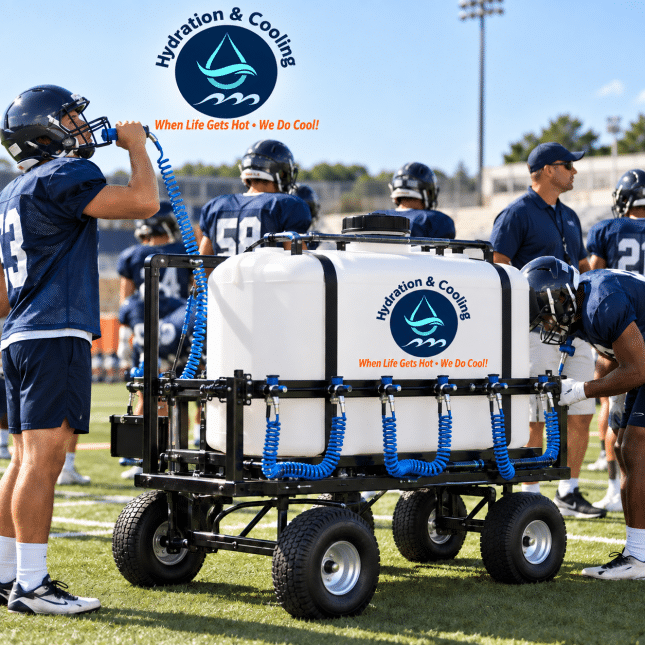
Football practice hydration equipment has a different job from a single sideline water cooler. Practice environments can involve large rosters, multiple position groups, long practice fields, changing drill locations, preseason camps, and more than one practice area.
For coaches, athletic directors, athletic trainers, and equipment managers, the goal is to create a hydration setup that fits the way the football program actually practices.
That means considering where athletes train, how many players need access at one time, how far equipment must move, whether a water connection is available, how equipment will be replenished, and where systems will be stored between practices.
Hydration & Cooling provides football hydration equipment ranging from portable team water tankers and water wagons to rolling hydration carts, football water stations, and team practice hydration packages. Current product options include both mobile tank-based systems and hose-connected stations. Hydration & Cooling Sports Equipment
Key Insight
What Hydration Equipment Does a Football Team Need for Practice?
Football practice hydration equipment may include team water tankers, portable water wagons, rolling hydration carts, hose-connected football water stations, hydration station trees, and smaller mobile water systems. The right combination depends on roster size, practice-field layout, number of practice locations, water access, mobility requirements, storage, replenishment, and budget.
What Matters Most
A football practice hydration system should be designed around the way the team actually trains.
Consider:
- Number of athletes and position groups
- Number and location of practice fields
- Centralized versus distributed hydration
- Tank capacity and dispensing points
- Hose or water-source availability
- Equipment mobility
- Replenishment requirements
- Storage and transportation
- Practice schedule
- Tournament, camp, and travel requirements
- Cleaning and routine maintenance
- Available budget
Larger programs may benefit from combining a high-capacity team water tanker with smaller mobile stations. Programs with convenient water connections may prefer hose-connected football water stations. Teams practicing across multiple areas may need several mobile hydration units rather than one centralized system.
Table of Contents
Why Football Practice Hydration Equipment Requires Planning
Football practices are rarely static.
A team may begin with warm-ups in one area, move into position work, use separate offensive and defensive stations, conduct conditioning drills, and finish at another location. During preseason or training camp, the schedule may involve multiple sessions or multiple fields.
That makes equipment placement just as important as equipment capacity.
A hydration system that works well beside a single practice field may be less practical when athletes are spread across a large facility. Conversely, several smaller stations may be unnecessary when the entire team remains in one centralized practice area.
The first question should therefore be:
How does the football program actually use its practice facilities?
From there, the equipment can be matched to the operation.
Football Practice Hydration Equipment Options
Football programs have several equipment configurations available. The best choice depends on the facility, roster, practice structure, and available infrastructure.
Team Water Tankers and Water Wagons
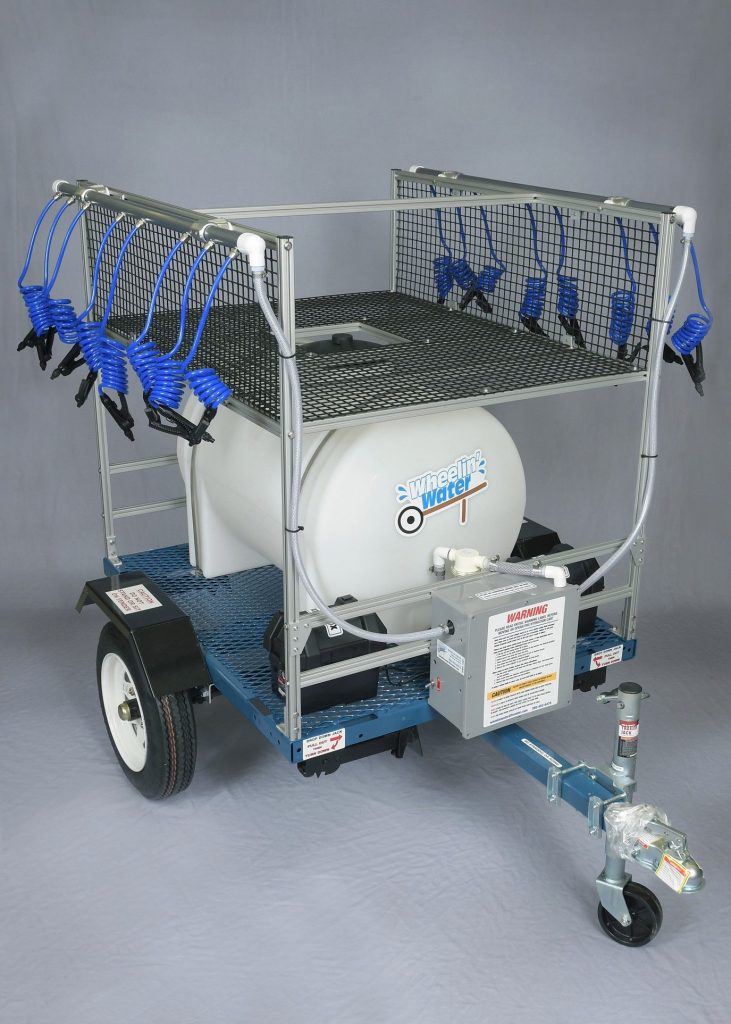
Team water tankers and water wagons provide larger-capacity mobile hydration for football programs that need to move water around a practice facility.
Hydration & Cooling’s current sports hydration category includes rechargeable 35-gallon, 50-gallon, 65-gallon, and 100-gallon systems, along with team practice packages and other hydration equipment. Hydration & Cooling Sports Equipment
These systems can be useful when:
- Practice fields do not have convenient water connections
- Large groups need centralized access
- Equipment must move between locations
- A program needs substantial water capacity
- The same equipment will be used for practices and games
For a broader look at football equipment selection, the site’s Football Hydration Equipment Guide can serve as the primary equipment resource.
Our Hydration and Cooling Equipment
-
50 Gallon Rechargeable Portable Water Wagon | 10 & 16 Hose Models – USA MADE!
$3,800.00 -
Best 65 Gallon Rechargeable Football Water Cow | Made In USA | New Low Price!
$5,090.00 -
Best Team Sports Hydration Station – Rechargeable 35 Gallon Tanker For 8 Players
Original price was: $2,790.00.$2,590.00Current price is: $2,590.00. -

Constant Chill Sports Cool Cart | Hydrates 6 Athletes
$1,290.00 -

Efficient 20 Player Team Practice Hydration Package | Our Hydration Station Combo
$3,390.00 -

Excellent Team Hydration Station Tree | Serves 8
$590.00 -
Our #1 Game Day Package | Team Misting Fans Cooling Station + Hydration Tanker
Original price was: $5,750.00.$5,390.00Current price is: $5,390.00. -
Our Best Football Water Station Serves 6 In Pads
Original price was: $1,190.00.$1,090.00Current price is: $1,090.00. -
Portable 35 Gallon Rechargeable Water Wagon | Made In USA!
$3,190.00




Rolling Hydration Carts
Smaller rolling hydration carts can provide more flexibility when teams need hydration equipment closer to individual position groups or separate training areas.
Current Hydration & Cooling options include 10- and 20-gallon mobile hydration carts with aluminum frames, rechargeable systems, large openings for filling and cleaning, and wheels designed for moving the units across different surfaces. Hydration & Cooling Sports Equipment
These systems can make sense when:
- The team uses several practice areas
- Smaller groups train separately
- Equipment needs to fit through doors or gates
- Transportation is important
- Multiple smaller stations are preferable to one large system
Hose-Connected Football Water Stations
A hose-connected football water station is another approach.
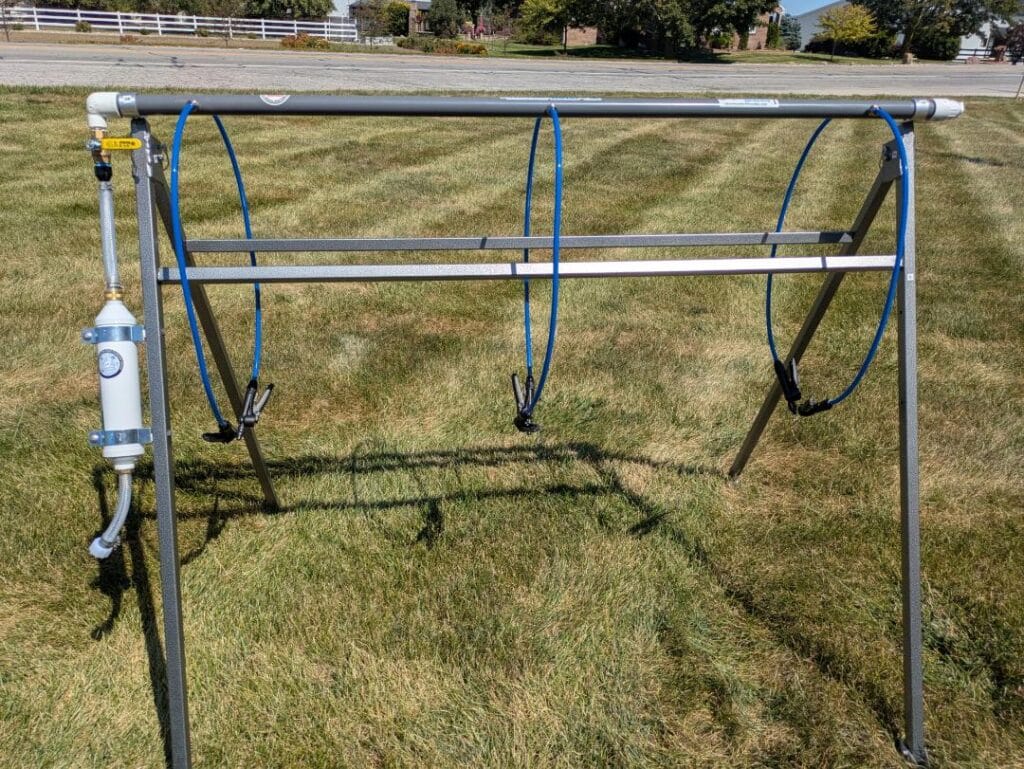
Hydration & Cooling’s current football water station connects to a clean water source and uses six drinking nozzles on food-grade hoses. The aluminum frame folds for storage, and the station can be moved around a practice field or sideline. Hydration & Cooling Sports Equipment
This type of system can be appropriate for facilities with reliable water access.
The advantage is straightforward: the team does not need to transport a large tank of water when a suitable water connection is already available.
Choosing Between Centralized and Distributed Hydration
One of the most important decisions for a football practice is whether hydration equipment should be centralized or distributed.
Centralized Hydration
A centralized setup places the primary hydration equipment in one designated location.
This can work well when:
- The practice area is compact
- Players regularly return to the same location
- Coaches use scheduled hydration breaks
- Staff prefer one primary equipment location
- Water replenishment is easiest at a central point
A large mobile tanker or water wagon can serve as the central hydration resource.
Distributed Hydration
A distributed approach places multiple hydration stations around the practice facility.
This may be useful when:
- Offensive and defensive units train separately
- Position groups use different areas
- The practice field is large
- Multiple fields are in use
- Players need access at different points during practice
Hydration & Cooling’s current Water Coolers & Stands category includes hydration station trees, football water stations, powered team drinkers, smaller hydration carts, and a team practice hydration package. Hydration & Cooling Sports Equipment
The decision is not simply about buying more equipment. It is about matching equipment placement to the movement of the team.
Matching Equipment to Practice Locations
Before selecting equipment, map the practice environment.
Identify:
- Main practice field
- Secondary practice fields
- Position-group areas
- Warm-up areas
- Conditioning areas
- Indoor training spaces
- Weight room
- Equipment storage
- Water connections
- Electrical connections
- Vehicle and cart access
Then determine where athletes actually spend time.
A hydration station placed beside a field is only useful if athletes can access it efficiently during the normal practice structure.
For a program using several fields, mobile equipment can provide flexibility. Smaller carts can serve individual areas while a larger tanker provides the primary water supply.
For programs with fixed water access, hose-connected stations can reduce the need to transport large water tanks.
Planning Hydration for Different Football Program Sizes
High School Programs
High school football programs often need equipment that can support both daily practice and game-day operations without creating unnecessary complexity.
A combination of larger mobile equipment and smaller stations may allow the program to use different configurations depending on the practice schedule.
A high school program should consider:
- Varsity and sub-varsity teams
- Number of practice fields
- Shared equipment between teams
- Storage space
- Transportation
- Budget
- Water access
College Programs
College football facilities can involve larger rosters, multiple practice areas, training facilities, and more complex equipment logistics.
College programs may benefit from assigning specific hydration equipment to:
- Main practice fields
- Position-group areas
- Training areas
- Indoor facilities
- Game-day sidelines
The equipment plan can also account for travel and storage requirements.
Professional and Organized Programs
Professional and larger organized football programs may have dedicated equipment staff and more extensive facility infrastructure.
For these programs, the important questions may include:
- How many hydration points are required?
- Which systems are permanently assigned?
- Which equipment must remain mobile?
- What equipment travels?
- Where is equipment stored?
- How is equipment inspected between uses?
The same principles apply regardless of program level: equipment should match the facility and the way the team operates.
Mobility, Storage, and Transportation
Football practice equipment needs to move.
A hydration system may travel from storage to the practice field each morning and then move again as the practice location changes.
Consider:
- Wheel design
- Equipment dimensions
- Weight when filled
- Door and gate clearance
- Vehicle transportation
- Storage footprint
- Battery charging
- Hose storage
- Seasonal storage
Smaller hydration carts can be particularly useful where equipment must move through doors or gates. Hydration & Cooling’s current 10- and 20-gallon carts are designed around mobility and storage considerations. Hydration & Cooling Sports Equipment
Larger systems may be better suited to programs where equipment can remain near the practice facility or be transported using appropriate team equipment vehicles.
Water Supply and Replenishment
Water availability is another major planning factor.
A football program should determine:
- Where clean water is available
- How equipment will be filled
- How frequently systems need replenishment
- Who is responsible for filling equipment
- Where ice or cooling resources will be stored if used
- How equipment will be returned to storage
A hose-connected station can be a practical option where the facility has an appropriate clean water connection. Tank-based systems provide greater independence from a fixed connection but require a plan for filling and transporting the water.
The right choice depends on infrastructure rather than simply the size of the equipment.
Cleaning and Equipment Maintenance
Practice equipment is used repeatedly, so maintenance needs to be part of the operating plan.
Hydration equipment should be cleaned, inspected, and stored according to the manufacturer’s instructions.
Before practice, staff can check:
- Tank condition
- Hoses
- Drinking nozzles
- Pumps
- Connections
- Wheels
- Frames
- Battery condition
- Water supply
After use, equipment should be cleaned and stored appropriately.
The site’s current Water Coolers & Stands category includes equipment ranging from hose-connected hydration stations to powered mobile drinkers and larger practice packages, so maintenance requirements can vary by system. Hydration & Cooling Sports Equipment
Building a Football Practice Hydration System
The best football practice hydration system is not necessarily the largest system available.
It is the system that fits the program.
Start with the practice environment.
Then evaluate:
1. Roster and group size
Determine how many athletes need access and whether they practice together or in separate groups.
2. Practice-field layout
Identify how far athletes move between drills and where hydration equipment can be positioned without interfering with practice operations.
3. Water infrastructure
Determine whether clean water connections are available and practical.
4. Mobility
Decide whether equipment needs to move between fields, buildings, or training areas.
5. Capacity
Select tank capacity based on the program’s actual operating requirements and replenishment plan.
6. Dispensing access
Consider how many athletes should be able to use the system at one time.
7. Storage
Make sure equipment can be stored securely and conveniently between practices.
8. Maintenance
Establish responsibility for cleaning, inspection, charging, and seasonal preparation.
9. Budget
Consider both the initial equipment purchase and the operational requirements associated with the system.
10. Future use
Consider whether the equipment will also support games, camps, tournaments, other sports, or shared athletic-department use.
For programs that need additional context around overall football hydration equipment selection, see the Football Hydration Equipment Guide. For programs planning water capacity, see How Much Water Does a Football Team Need? For broader scheduling and program organization, see the Football Hydration Plan.
Frequently Asked Questions
What equipment is best for football practice hydration?
The appropriate equipment depends on roster size, practice-field layout, water access, mobility, and replenishment requirements. Options include team water tankers, water wagons, rolling hydration carts, hose-connected football water stations, hydration station trees, and team practice hydration packages.
Should a football practice use one large hydration station or several smaller stations?
Either approach can work. A centralized system may fit a compact practice area, while several smaller stations may be more practical when offensive, defensive, and position groups practice in different locations.
Are mobile hydration systems useful for football practice?
Yes. Mobile systems can be useful when equipment needs to move between practice fields, position areas, indoor facilities, or other training locations. Hydration & Cooling currently offers mobile carts and larger tank-based systems designed for different operating requirements. Hydration & Cooling Sports Equipment
What should a football program consider when choosing a hydration cart?
Consider capacity, mobility, dimensions, water source, dispensing configuration, storage, cleaning access, transportation, and the number of athletes the cart needs to serve.
Can a football water station connect directly to a hose?
Yes. Hydration & Cooling’s current Football Water Station is designed to connect to a standard hose from a clean water source and provides six drinking nozzles. Hydration & Cooling Sports Equipment
Should football practice hydration equipment also be used on game day?
It can be, depending on the equipment and program requirements. Programs should consider sideline layout, transportation, capacity, access, and whether additional game-day equipment is needed.
Conclusion
Football practice hydration equipment should be selected around the way a football program actually practices.
The right system may be a large mobile water tanker, a smaller hydration cart, a hose-connected football water station, several distributed hydration stations, or a combination of equipment.
The important factors are not simply capacity or price.
A practical equipment plan considers roster size, practice-field layout, water access, mobility, replenishment, storage, maintenance, transportation, and future use.
For football programs, the objective is to create organized hydration access that fits naturally into practice operations.
Hydration & Cooling provides a range of team hydration equipment that can be configured for different football facilities and operating requirements, including mobile water tankers, water wagons, rolling hydration carts, football water stations, and practice hydration packages. Hydration & Cooling Sports Equipment
Need Help Choosing the Right Football Practice Hydration Equipment?
Hydration & Cooling has more than 25 years of experience helping coaches, athletic directors, schools, teams, equipment managers, and organizations select hydration and cooling equipment appropriate for their needs and budget.
Monday–Friday, 10 AM–5 PM EST